Friday, October 25, 2013

I Have the Chicken Pox


 …or at least my fifth graders think so!

It all started the day Laxman-sir, my headmaster, walked into the staffroom and asked, “So, how do you feel about teaching science?”

Heck, as long as it’s not math, I’ll give it a go, I thought. The previous science teacher was recently reassigned to another school, leaving grades 4 and 5 without a science teacher. I gladly accepted the request, already picturing simple, but fun, experiments to try with the students. Baking soda volcanoes. Balloon rockets. 3-D solar system models. How difficult could it be?

Opening up to the lesson I was supposed to teach, I was given a rude awakening. Communicable and non-communicable diseases. Woof. Scanning the list, I realized the easiest way to explain things like whooping cough, mumps, and measles to my students would be through acting out symptoms. Which worked perfectly until we got to “chicken pox.”

“They’re spots on your skin that itch,” I explained, motioning to my arms and face. The students faces changed from mild interest to surprise to horror before they started whispering among themselves and looking nervously at me.

“Miss! Miss! You have chicken pox?!” brave Purnima asked for the rest of the class. She gestured wildly at my nose and cheeks. “Spots!”

And this is what happens, folks, when you don’t have enough Nepali to explain the difference between chicken pox and freckles…

Dashain: Mountains, Meat, and Mighty Ghars


18 October

Ladies and gentlemen, I can officially say I saw the famous Himalayas! The glimpses over the past few weeks pale in comparison to the stunning peaks that I saw as the clouds parted in Nargakot. They were so perfectly clear we could have been staring at a green screen. And yes, I am aware I just implied the Himalayas look “fake”…

We spent the first few days of Dashain re-visitng Kathmandu (it’s amazing how a few weeks of language practice can boost your confidence when bargaining for a hotel room!) before passing through to Nargakot, a town famous for its mountain views.  We fought off tarantula-sized spiders, rabid dogs, and crowded buses for the view–and it was all completely worth it!

Before I had the chance to unpack upon returning home, Didi swept me out the door with Stutat, Spandan, and my niece, Urmica, to watch the religious parade that kicks off the start of Dashain. I climbed to what felt to be the top of Gorkha with Stutat clinging to my back – essentially trading a full trekking pack for my 3-year-old brother– to watch the preparations for the parade. Instead of clearing the path, like I had anticipated, a small crowd gathered to coat the stone stairs with cow dung! “They’re cleaning the stairs,” Didi told me in Nepali. “A Nepali vacuum!”

One of the biggest aspects of Dashain is wearing tikka, which is made from a red rice paste and applied to the forehead. The elders in my family and around the village doled out this concoction which covered my entire forehead for three days, temporarily turning my skin pink and unfortunately giving everyone the impression I was constantly blushing! In addition to tikka, elders give paisa, or money, during Dashain and the amount varies according to your age. Unlike in the states where financial information is usually a private matter, it is not uncommon for Nepalis to ask, “How much did that cost?” or “How much do you make?” So I shouldn’t have been surprised when at the end of the day, the family gathered to compare how much everyone had collected. (Perhaps it’s because I have Halloween on my mind, but it reminded me of returning home from trick-or-treating and taking inventory of the night’s booty. Adults included!)

Dashain is the time of year when family returns home to celebrate with one another, so I joined my host family on a trip to Chitwan, where my bauyju’s mighty ghar, or material home, is located. The trip gave me the opportunity to try out all kinds of Nepali transportation: a bus packed so full there were people hanging out of the open door and perched precariously on the roof (believe it or not, we never lost anyone on the three hour pot hole-filled trip back from Chitwan…at least that I know of…), minibus, tuk tuk, rickshaw, a car that was dangerously close to being out of gas miles away from the nearest petrol pump, and motorbike. (I wish I had a picture of four people squeezed on the seat, bags dangling from the handlebars and a pink umbrella waving frantically overhead to shield us from the rain!) Had there been an elephant available, we may just have hopped on that too!

And eating. There. Was. So. Much. Meat. I think I may have eaten more in one meal than the PC Yuck Truck serves during an entire weekend. My usual strategy to eat faster than my brain can process what my stomach is doing backfired when even more meat was loaded onto my plate because my hosts assumed, “Gee! She must be hungry!” During Dashain there was plenty of meat to go around; at one temple in Kathmandu alone, worshippers watched as 14,721 goats were sacrificed over the course of the day. 14,721. In one day. I’m glad I was able to sit that one out.

And after 15 days of holiday, school will be back in full swing!

Friday, October 18, 2013

A is for Amala


October 4

Amalas. They’re weird little fruits that look a lot like grapes and get their name from “amilo” (sour), which describes their taste perfectly. The first time I was handed one by my teacher, I popped it into my mouth thinking it was its sweet, plump look-alike. I couldn’t be more wrong.

It was hard, like candy, and should be sucked, not chewed, which I learned the hard way after almost chipping a back molar. The teacher must have noticed my mouth pucker in surprise because she laughed and said (a little too late), “Amilo! Amilo! Dheri amilo!” As the sour juices hit the back of my throat, I was immediately reminded of the contests Bobby and I used to have with sour Cry Baby candies. On the scale of sour raspberry to black cherry, this one topped them all.

In Gorkha, amalas are as common as apples, and students present handfuls of them to their teachers as gifts. By the end of first period, the pocket of my uniform was bulging with these sour treats. “Amala mon parcha?” my students asked, excitedly. “Do you like amalas?” I replied yes, stretching the truth a bit, figuring that the taste would grow on me after I finished the pile stashed against my hip. However, this may not have been the best response –they brought even more the following day!

While the gifts of amala may have been an act of pure goodwill, I realized later they could also have been a means of softening me up for the chaos that was about to ensue in the classroom. Like in the states, my students’ attention span has been getting shorter and shorter as the holidays draw near. And let me assure you, it’s even more difficult when you don’t have the proper language skills for classroom management! By Thursday, it was all I could do to keep my 5th graders from flying out the door. They could only be entertained by making play-dough replicas of their Dashain feats (other than being blue, their roti, chow mein, and momo sculptures were spot on!). And Friday, the teachers didn’t even attempt to teach and instead held a school clean-up day, which lasted half of first period. Before leaving, my students crowded around to shake my hand and offer a “Happy Bijaya Dasami, Miss!” The smile on my face was bigger and cheesier than usual as they danced me out the door and waved goodbye, their bookbags flapping behind them as they raced home. 

Monday, September 30, 2013

It's Beginning to Look A Lot Like Christmas


It may be the last day of Septmeber, but my socially unacceptable habits of breaking out the Christmas carols well before the last Thanksgiving turkey drumstick has been picked clean have made me acutely aware of the festive atmosphere that’s spreading through the bazaar.

This can only mean one thing –Dashain!

The shopkeepers have dusted off their finest wares and are displaying them from hanging wires, on front steps, and even on their heads! With it being such an important time in the year for business (Black Friday, anyone?), I was honored to be promoted to “head shopkeeper” in my family’s shop this morning before school while everyone ran errands. And when I say sole shopkeeper, I mean that if anyone lingered outside looking even remotely interested, I pitched them my rehearsed speech in Nepali: “Hello! How are you? What are you looking for?” More often than not they were shocked that a foreigner was 1.) keeping shop and 2.) speaking Nepali. However, they then proceeded to reply with a list of items I don’t know the names of and/or where to find them between the stacks of buckets, bowls, and bottles of cleaner and I had to scurry upstairs to find someone to take care of the business transaction.

But Dashain is more than just the “SALE!” advertisements in the local paper. Like Christmas, it’s a time for visiting family, relaxing, and of course eating. I will be traveling with my family to visit extended family in Chitwan, learning how to cook Nepali dishes, wearing a langi, and trying not to get in the way of all the animal sacrifices right outside my front door...

Stay tuned for festival updates!

Sunday, September 29, 2013

…And some days you end up with goat’s head soup…


Forest Gump had it right when he said “ Life’s like a box of chocolates –you never know what you’re gonna get.”

Over the course of the last five weeks here in Gorkha, I recognize a number of my Western habits that have become apparent. One of the biggest realizations has been my dependence on a schedule, timetable, or some sort of fixed “norm” around which I can plan my daily activities. I’ve spent considerable time and energy trying to figure out who in my family does what and when to try and fit into their routine as seamlessly as possible. However, this has been near to impossible because life in Nepal has been full of surprises…

Sometimes its waking up to a parade outside your window –a parade of hundreds of men dressed in white, marching single file down the street, blowing horns, banging drums and leading a few dozen goats to their sacrificial demise.

Sometimes it’s arriving home from school to find that your three-year-old brother has fallen into your toilet. (Thank goodness the spider is gone –there wouldn’t be enough room for both of them!)

Sometimes it’s in the staffroom while you’re planning a lesson. Suddenly the bell rings, the students race from the school (despite there being two periods left) and voila! An unexpected half-day. The teachers then proceed to dress you up in traditional costume and have a heated discussion of finding you a suitable Nepali husband.

Sometimes it’s in the classroom when your back is turned. One of my grade 6 troublemakers took the opportunity to steal my blue sticky tack I was using for an activity, thinking it was chewing gum. (I found the culprit pretty easily –despite his vehement head shaking, there was a trail of blue string leading up to his mouth…) Other times you find yourself jumping off a desk in the front of the classroom trying to act out vocabulary in the story "The Greedy Fox." Never in my life did I think I'd be dressed in a hot pink kurta uniform, wearing a homemade fox mask, leaping from a wooden bench in front of 65 twelve year olds!
Thanks Lauren for these words of wisdom!
Co-teaching in action

Sometimes you don’t even make it to school. Although I’ve reached the five week mark, I’m still waiting to log in a full week of teaching. When I first found out that classes run from Sunday to Friday, I was initially surprised to only get one day off. However, between exams, festivals, and the bhundhs (political strikes that are a result of the upcoming November Congressional elections), there seems to be one reason after another why classes are cancelled. It’s kind of like getting snow days in the middle of summer!


...And sometimes, if you’re my friend Jeanie, it’s at the dinner table when you find yourself staring at a steaming bowl of goat’s head soup! 

Saturday, September 21, 2013

Ukus Mukus Bhayo

Yes, it sounds a lot like a weird spell -throw in a little "bubble, bubble, toil and trouble" and you can pretty much picture Bette Midler from Hocus Pocus dressed in her crazy witch wardrobe. 

But in Nepali, it literally translates to "I was so full I was suffocating" and have used this phrase daily since learning it. Between Nepali lessons with my dai, language immersion at home and flipping through flashcards in the staff room during free periods, I've started to expand my conversational Nepali beyond introductions. I can understand basic conversations i overhear on the street AND can negotiate a better price in the shop up the street for photocopying my class lessons. I even fooled my older host brother, who lives in Australia, that I was fluent when he called this morning. (That is, until he went off in Nepali and I had to admit defeat.)

On Thursday, as I sat with a full plate of vegetable curry and beaten rice during tiffin break at school (it's really a wonder how in the world I'm ever hungry when I return home!), some of the staff wanted to know how much dhal bhaat I am served at meals. "Dheri, dheri khaana!" I replied, motioning with my hands to a pretend mountain of rice. "Ukus mukus bhayo!"

What I didn't expect was for the entire staff room to erupt in laughter, with everyone pointing, saying, "Did you hear her?! Ukus mukus bhayo!"
"Amisha-miss, you speak perfect Nepali. We are so proud of you," said Ananta-sir. 

While far from perfect, I appreciated the compliment and it has served as motivation to continue with my Nepali practice. That and the fact that I need some way to manage my 62 sixth graders on the days I teach alone...

Saturday, September 14, 2013

Teej!


8 September 

…Otherwise known as the festival where I was pushed on stage to dance in front of the entire village of Gorkha and interviewed for the local radio station. In Nepali, of course!

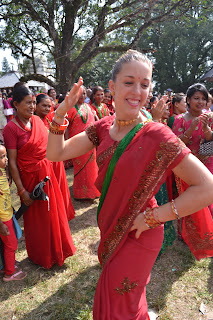
It began with a 5am start Saturday morning when my baujyu ushered me out of bed to begin preparation for the Teej women’s festival. Wrapped, re-wrapped, and re-re-wrapped in a bright red sari, I had a firsthand account of how my Barbie dolls used to feel as I was primped, pinned, and prodded by every member of the family, who each had their own opinion of how the drape should fold and skirt should tuck. Just when I thought I was ready to go, my dai rushed in with a bag of hair supplies. An hour later, he had fixed me a beautiful prom-worthy hairstyle that required more bobby pins than I used for my junior and senior formals. Combined. I donned a bunch of borrowed gold jewelry (so much so that I was not allowed to walk around by myself in case I was mugged. Very subtle.) and was ready for the walk to the NELTA office, where the ETAs assist with extra English programs and cultural activities. And Teej was a cultural event we were told we didn’t want to miss.
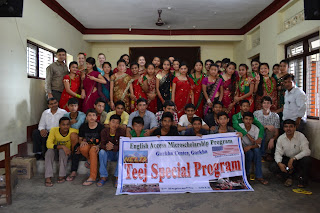
Once a year, Nepali women return to their mighty garr (maternal homes) and celebrate with singing, dancing, and showing off their finest outfits. Oh, and fasting. It is customary for women to spend the day fasting for the long life of their husbands and after 3 weeks of mountains of rice, I was ready to welcome the short reprieve. I was informed that morning, however, my family does not practice that tradition when a bigger than usual rice peak arrived on the table in front of me. Apologies to my future husband –looks like you’re not off the hook for exercising and healthy eating…

We spent the day dancing with our students, feasting on Teej dar (rice pudding and vegetable curry) before returning home to rest and repeat the next day. Following the throngs of elegantly dressed women to the nearby temple, my didi and I passed some of my students along the way.
“Raamro nacchnu! Dheri dheri raamro nacchnu,” they all giggled, pointing at me. “Beautiful dancing.”
Why, thank you, I thought. This caused my didi to speak enthusiastically (read: so quickly it was beyond comprehension) although I was able to catch bits and pieces. Dancing. Stage. Camera. Photo. America.
Yes, I thought. I’m definitely going to take plenty of photos to show my family and friends at home.

Ten minutes later when I found myself being pulled onto the stage, I realized that my translation had been a bit off… I was the one that would be dancing on stage. When the split-second moment of panic wore off, I pretended I knew what I was doing and mimicked the dancers around me –then added in some moves of my own. (If you see any future Nepali music videos featuring moves that look suspiciously like the Macarana with a few wrist flicks and hip shakes, you can probably guess why…)

Smiling and sweating, I made my way to the stage steps once the music finally slowed. But before I could escape to freedom, the MC grabbed my arm and pushed a microphone at my face.
“Just a few questions,” her voice crackled over a dozen loudspeakers positioned around the grounds. “Can you tell us you’re name, where you’re from and how you like the Teej festival?”
I silently thanked Prava-ji for her month of language training and the ability to respond in Nepali.
“Mero naam Amisha Shrestha ho ra mero desh America ho. Yo dheri dheri raamilo chaa!”

Even hours later, Didi was still laughing and showing me off to everyone we passed. “FM radio! FM radio!” she called out, again pointing to me. Not only did all of Gorkha witness my dancing, but for anyone missing out at home, they could tune into my radio interview. And that, ladies and gentlemen, is how one slightly confused and overwhelmed, yet excited American got her Nepali claim to fame!